Your NYSEG bill is four pages long, but almost all of it comes down to a question: what did you actually pay for electricity last month? Between the delivery charges, the supply charges, the transition and recovery fees, and a couple of taxes, that answer is harder to find than it should be. So let’s go through a real NYSEG bill line by line and find it together. By the end you’ll be able to pick up your own statement and know exactly what every charge is.
The bill I’m using is a real one from a home in Peru, up in Clinton County. One month of electricity, 757 kilowatt hours, billed late June to late July 2026. Nothing unusual about it, which is exactly why it’s a good one to learn from.
Your NYSEG Account Summary explained
The front page is the short version. Your name and account number up top, the service address, the amount due, and a little “Account Summary” box that’s mostly about last month, not this one.
That box trips people up, so here’s how to read it: the previous invoice is what last month’s bill was, the payment line is what you paid against it, and the balance forward is whatever’s left. On this bill the balance forward is $0.00, which is what you want to see. It means last month got paid in full and nothing is rolling over. Underneath that, “Energy charges” is the real number for this month, and “Miscellaneous charges” is the small stuff (a billing fee, a tax on that fee) that we’ll get to.
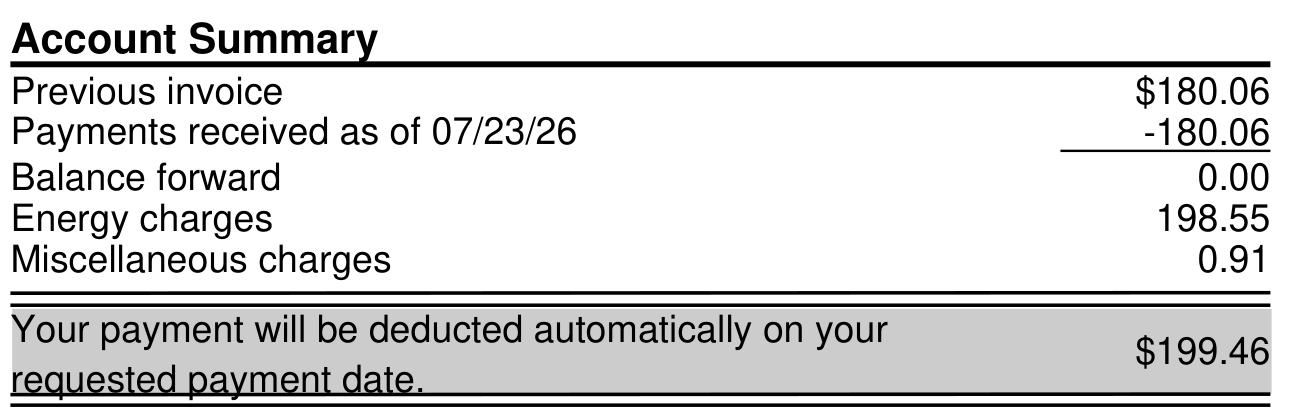
One habit worth building: glance at the “Payments received” date every month, just to confirm your last payment actually landed. A missed autopay is a lot easier to fix in month one than in month three.
Supply vs delivery charges on your NYSEG bill
Turn to page three, the one headed “NYSEG Detailed Account Activity.” This is where the real story is, and the first thing to understand is that your electricity charge is built from two completely separate piles.
One pile is supply – the actual energy your house pulled from the grid. NYSEG buys it and passes the cost straight through to you with no markup. On this bill that came to $89.56.
The other pile is delivery – what NYSEG charges to carry that energy over the poles and wires to your house. On this bill, $106.81.
Look at those two numbers side by side. Delivery is the bigger one. It cost this household more to move the electricity than to buy it. And that’s the pile you have almost no control over, because NYSEG owns the wires in their territory and nobody else is allowed to run a competing set. You can shop around for a cheaper supplier all day long. The delivery charge doesn’t care.
Let’s take each pile apart, starting with delivery, since it’s the bigger one.
NYSEG delivery charges explained
Here’s the whole delivery section from the bill. Six lines.

Basic service charge – $19.00. This is the flat fee just for being connected. It shows up whether you use 757 kilowatt hours or none at all. Go on vacation, shut everything off, and you’ll still get billed $19 for the month. It covers the meter, the reading, and a slice of the delivery system.
Delivery charge – $69.17. This is the real one, the per-kilowatt-hour cost of moving your power. NYSEG charged about 9.1 cents per kWh here, and this single line is the biggest charge on the entire bill. It’s also the number NYSEG has been trying hard to raise, which we’ll come back to.
Transition charge – $4.72. This is a catch-all NYSEG uses to recover the cost of a bunch of state programs, things like EV charging infrastructure, energy storage, and various rate-adjustment mechanisms. The bill bundles them into one line so you don’t see a dozen tiny charges, but that also means you can’t see exactly what you’re paying for.
Revenue decoupling mechanism – $1.40. This one is a little maddening. It’s a true-up between what NYSEG forecast they’d collect in delivery revenue and what they actually collected. If everybody in your area uses less power than expected, NYSEG is allowed to collect the shortfall through this line. In plain terms: if the whole neighborhood conserves, NYSEG’s delivery income is still protected. It’s a big part of why “just use less” doesn’t help as much as you’d hope.
SBC charge – $5.01. The System Benefits Charge, a state-mandated fee that funds clean-energy and efficiency programs through NYSERDA. Every electric customer in New York pays it. It’s also, worth noting, part of what funds the state’s solar incentives.
Recovery charge – $7.51. This is a specific one. It’s storm-cost financing. NYSEG borrowed money to cover major storm damage, and this line pays that debt back over time. It’s literally being collected on behalf of an entity called NYSEG Storm Funding, LLC. When people say weather is making their electric bill go up, this is one of the places it’s happening in black and white.
Add those six up and you get $106.81. Notice how little of it is really about the electricity you used. The two biggest pieces are the fixed connection fee and the delivery rate, and almost everything else is a program or a true-up or a debt repayment. That’s the part of your bill you can’t shop, can’t opt out of, and can’t lower by being careful.
NYSEG supply charges explained
This one’s simpler.

Supply charge – $86.61. The actual electricity, at about 11.4 cents per kWh this month. This is the pile that moves with the energy market, so it drifts up and down month to month depending on fuel prices and demand. NYSEG makes no profit here, page two of the bill even spells out their supply price for the month and tells you that you’re welcome to compare it against a third-party supplier.
Merchant function charge – $2.95 (split into two small lines because the billing period crossed two rate months). This is what NYSEG charges to actually go buy the energy for you and handle the purchasing overhead. If you switched to an ESCO (a third-party energy supplier) this charge would go away, because you’d be buying your supply from them instead.
That’s the whole supply side: $89.56. Simpler than delivery, and it’s the only half of your bill where you have any real ability to shop around.
How to calculate your real cost per kWh
Ask most people what they pay per kilowatt hour and they’ll point at the supply rate – around 11 cents on this bill. But that’s just the energy. It leaves out the entire delivery pile and the taxes. Your real rate is everything added together, divided by what you used.
So let’s do it. The total electricity cost on this bill was $198.55, and the home used 757 kilowatt hours.
$198.55 ÷ 757 = about 26 cents per kilowatt hour.
That’s the real number. Not 11 cents, not 9 cents – 26. More than double the supply rate this homeowner would have quoted you if you’d asked. Your bank account never feels the supply rate on its own; it only ever feels the total. And the total, divided by your usage, is what you’re actually paying for electricity.
If you want to find your own, it’s the same two steps: take your “Total Electricity Cost” and divide by the “Billed Usage” in kilowatt hours. Both numbers are right there on page three. Most people are surprised how high it comes out.
How to read your NYSEG usage graph
Down at the bottom of page three, NYSEG prints a bar graph of your last thirteen months, and next to it a small table comparing this month against the same month a year ago. Almost nobody looks at this, and it’s one of the most useful things on the whole bill.
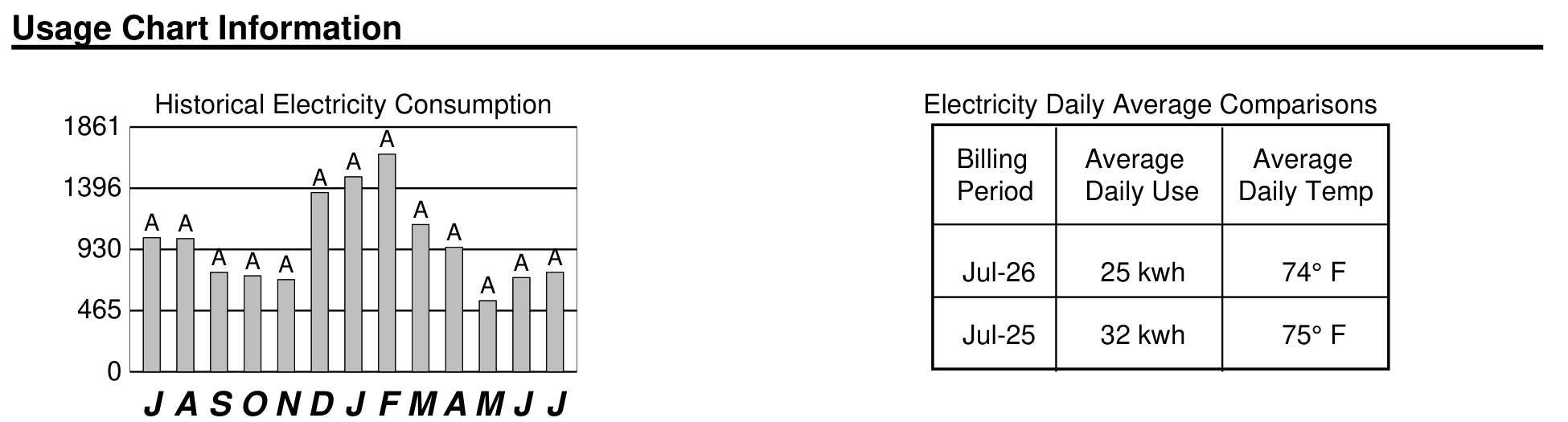
Look at that little comparison table on the right. This July, the home averaged 25 kilowatt hours a day. Last July, 32. And the average temperature was basically identical – 74 degrees this year, 75 last year. Same weather, meaningfully less power. Something in that house changed, maybe an old appliance got replaced, maybe the AC habits shifted, and the bill reflects it.
That’s what this graph is for. It smooths out the noise of any single month and shows you your actual pattern. If your tall bars are in summer, you’re cooling-driven. If they’re in winter, you’re heating-driven, which usually means electric heat or a heat pump. And when you’re ready to figure out whether solar makes sense for your house, this thirteen-month view or better yet, a full year pulled from your online account, is the first thing anyone should look at. A quote built on one bill is a guess. One built on a year of real usage is a plan.
The NYSEG rate increase in 2026
Now the part that’s genuinely up in the air, because NYSEG’s rate situation in 2026 is different from the other New York utilities.
Most of the big NY utilities – Con Ed, National Grid, Central Hudson – got multi-year rate increases approved in 2025 and early 2026, and those are already showing up on bills. NYSEG is a different story. They asked for one of the largest increases any New York utility has requested in recent memory: roughly a 35% jump in electric delivery rates, which would have meant something like a 23% increase to the average total bill, and around $33 more a month for a typical home.
The Public Service Commission didn’t grant it. Instead, in mid-2026, regulators put temporary rates in place – increases small enough that the average bill barely moved, under 3% – while they keep digging into the case. Part of the holdup is an audit of NYSEG’s operations that’s still working its way through. In other words, the big increase NYSEG wanted hasn’t happened, but it also hasn’t gone away. It’s paused, under review, and the final number could still land higher once the case wraps up.
We wrote about the broader New York rate picture, NYSEG included, if you want the full context: Why New York Electric Bills Are About to Spike Again.
The reason this matters for how you read your bill: the charge NYSEG is fighting to raise is the delivery charge – the one you can’t shop around, can’t opt out of, and can’t lower by using less. Which brings us to the one thing you actually can do.
How to lower your NYSEG bill
Some of this you can act on. Start with the free stuff.
Check whether you qualify for NYSEG’s Enhanced Energy Affordability Program. They’ve expanded who’s eligible for monthly bill credits, and plenty of households that qualify never sign up. The details are on NYSEG’s site under HelpWithBill.
Look at your supply rate and decide whether shopping it makes sense. NYSEG prints their monthly supply price right on page two so you can compare it against ESCO offers – just read those contracts carefully, because variable-rate deals have burned a lot of people, and switching only ever touches the supply half of your bill anyway.
Make sure your meter reads say “Actual” and not “Estimate,” and check the number of days in your billing period before you panic about a jump. A 34-day month costs more than a 27-day month for reasons that have nothing to do with rates.
Then, honestly, come to terms with the ceiling. Better insulation, a smart thermostat, efficient appliances – all of it helps, and you saw on that usage graph how real the savings can be. But look back at the delivery section. The basic service charge doesn’t move when you cut back. The delivery rate applies to every kilowatt hour you do use. And the revenue decoupling mechanism exists specifically to protect NYSEG’s delivery income when customers conserve. Using less helps. It doesn’t get you off the treadmill.
Where solar fits in
Full disclosure before this part: we install solar. So read it with that in mind, and check the math against your own bill rather than taking my word for it.
Everything I just walked you through is a cost pointed in one direction, set by a rate case you’re not part of, on a service with no competitor. Using less changes how much you buy. It doesn’t change which way the price is headed.
Making your own power changes what you’re exposed to. Every kilowatt hour your roof produces is one you’re not buying at 26 cents all-in and not buying at whatever that becomes if NYSEG’s big increase eventually goes through. It won’t cut you loose from the grid completely. You’ll still have a meter, you’ll still pay that $19 basic service charg. Anybody who tells you solar makes the whole bill vanish is overselling it.
What solar actually does is take the biggest, fastest-growing line on your bill – that delivery charge on every kilowatt hour, the one NYSEG keeps trying to push higher – and replace most of it with a number you lock in today. Whether it pencils out for your house depends on your roof, your usage, your shade, and the incentives you qualify for. Which is exactly why that thirteen-month usage graph is where the conversation should start.
NYSEG Bill FAQ
Why is my delivery charge higher than my supply charge? Because delivery covers the whole distribution system – the fixed service charge, the per-kWh delivery rate, and a stack of state programs and true-ups – while supply is just the energy. On this bill, delivery ran $106.81 against $89.56 for supply.
What is the Recovery charge on my NYSEG bill? It’s storm-cost financing. NYSEG borrowed money to cover major storm damage, and this line repays that debt over time. It’s collected on behalf of NYSEG Storm Funding, LLC.
What’s the Transition charge? A catch-all that recovers the cost of several state programs: EV charging, energy storage, and various rate-adjustment mechanisms bundled into one line.
What is the Revenue Decoupling Mechanism? A true-up that lets NYSEG collect the difference when actual delivery revenue comes in below forecast. It’s the reason neighborhood-wide conservation doesn’t cut NYSEG’s delivery income the way you’d expect.
Will switching to an ESCO lower my bill? It can change your supply cost and it removes the merchant function charge, but it does nothing to your delivery charges, because NYSEG still owns the wires and still bills you for delivery.
How do I find my real cost per kWh? Take the “Total Electricity Cost” on page three and divide by the “Billed Usage.” Almost everyone lands well above the supply rate printed on the bill.
See your own number
Pull your last twelve months of usage from your NYSEG account and take two minutes with the survey below. We’ll put together a free savings plan showing what your roof would produce, what it would cost, and how it stacks up against a bill that could still climb if NYSEG’s rate case goes their way.