Here’s something strange about the Central Hudson bill I’m about to walk you through. The homeowner used 359 kilowatt hours in April. A year earlier, same month, they used 504. That’s 29% less power this time around. You’d expect a bill that dropped by about a third. It didn’t. And by the end of this, you’ll understand exactly why, because it comes down to how a Central Hudson bill is built, and how little of it is actually about the electricity you use.
I’m going to take a real bill apart, line by line, and show you where every dollar goes. It’s a residential account in Kingston, one month of electric service, billed mid-March to mid-April 2026. Grab your own Central Hudson bill and follow along, everything I point to is on yours too, in the same spots.
The Two Halves of a Central Hudson Bill
Turn to page three, the detailed billing page. Your electric charges split into two groups.
Supply is the electricity itself – the actual power your home pulled off the grid, priced at the market rate. Central Hudson buys it and passes the cost to you without profit. On this bill, supply came to $51.39.
Delivery is what Central Hudson charges to carry that electricity over the poles and wires to your house. It’s the part the state regulates through rate cases, and it’s the part that’s been climbing. On this bill, $78.38.
Now, on some utility bills, delivery is the bigger number because the delivery rate is sky-high. Central Hudson is a little different. This month the delivery rate was about 13.9 cents per kilowatt hour, and the supply rate was actually higher, around 18 cents. So why is the delivery total still bigger? Because delivery is where all the fixed charges and add-ons live: the flat monthly fee, the riders, the adjustments, and those don’t shrink when your usage does. That’s the thread to pull, so let’s pull it.
Central Hudson Delivery Charges, Explained
Here’s the entire delivery section from the bill. Eight lines. Only one of them is really “delivery.”
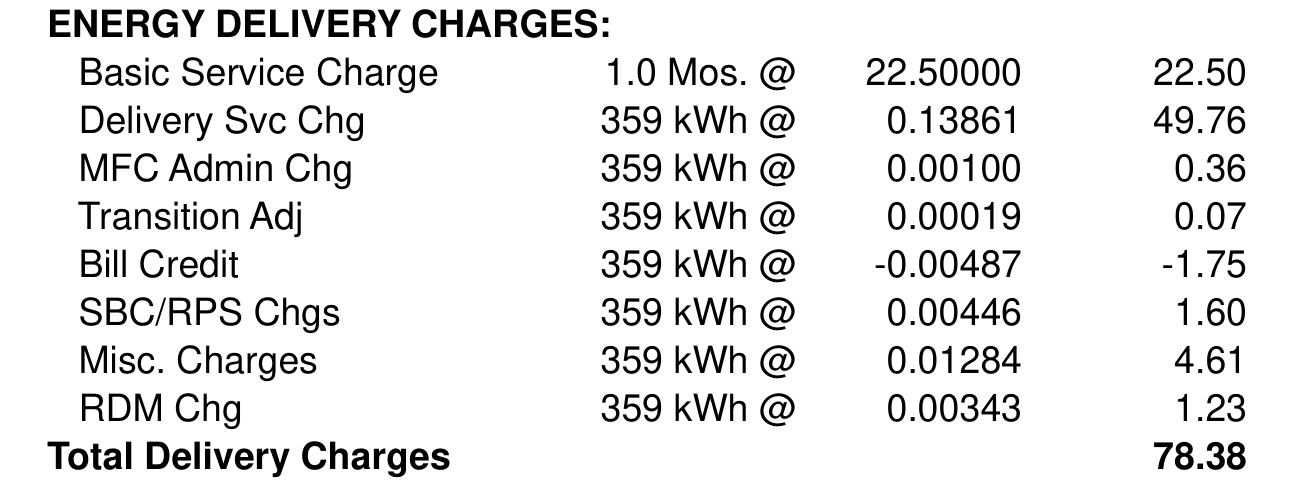
Basic Service Charge – $22.50. This is a flat fee, charged once a month no matter what. It’s not per kilowatt hour. Use 1,000 kWh or use nothing at all, it’s $22.50 either way. This single line is why a lighter-usage month still lands with a real bill, you’re paying it before you’ve turned on a light. And it’s rising: Central Hudson’s approved rate plan takes this charge up over the next couple of years.
Delivery Svc Chg – $49.76. This is the real per-kilowatt-hour delivery charge, about 13.9 cents times the 359 kWh used. This is the biggest single line on the electric bill, and it’s the one Central Hudson’s rate increases are actually raising. Notice, though, that it’s the only big line here that responds to your usage. Everything under it is small and mostly fixed.
MFC Admin Chg – $0.36. The administrative slice of the Merchant Function Charge – Central Hudson’s cost of arranging your energy supply. Tiny.
Transition Adj – $0.07. A small adjustment that recovers the cost of assorted state programs. Pennies.
Bill Credit – –$1.75. An actual credit, one of the few things on here moving in your favor. It’s subtracted.
SBC/RPS Chgs – $1.60. The System Benefits Charge and Renewable Portfolio Standard – state-mandated fees that fund clean-energy and efficiency programs through NYSERDA. Every New York customer pays into this, and it’s part of what bankrolls the state’s solar incentives.
Misc. Charges – $4.61. A catch-all line. Small, but not nothing.
RDM Chg – $1.53. The Revenue Decoupling Mechanism, and that one is a little maddening. If Central Hudson collects less delivery revenue than the state said they could, they’re allowed to recover the shortfall through this charge. Essentially, if everyone in your area uses less electricity, Central Hudson’s delivery income is protected anyway. It is, almost literally, a charge designed to blunt the effect of everyone conserving.
Add it all up and delivery is $78.38. But look at what actually drives it: the $22.50 flat fee and the $49.76 delivery charge are 92% of it, and only the second one has anything to do with how much power you used. So when this household cut usage by 29%, only the delivery charge portion shrank. The flat fee didn’t. The riders didn’t. So the bill barely flinched.
Central Hudson Supply Charges, Explained
The supply side is shorter and simpler.
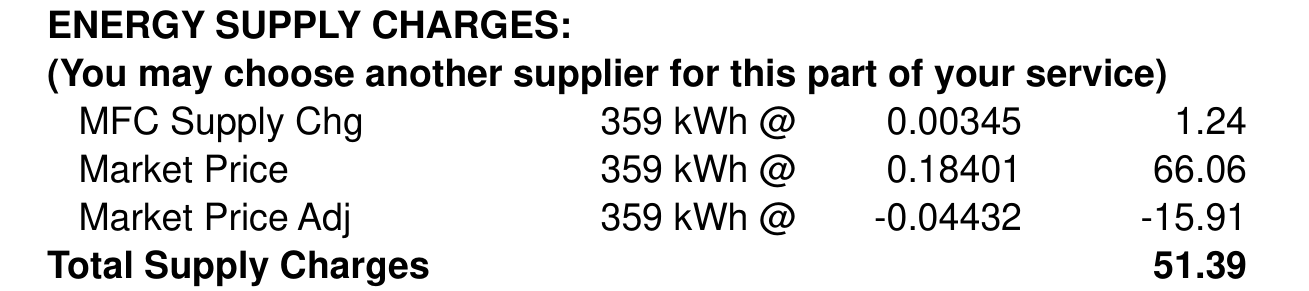
Market Price – $66.06, with a Market Price Adj of -$15.91, nets to about $50 for the raw energy. This is the market cost of the electricity itself, and it swings month to month with fuel prices and demand. Central Hudson earns no profit here, they even print a note telling you the average price they paid so you can compare it against other suppliers.
MFC Supply Chg – $1.24. The supply portion of the Merchant Function Charge – the cost of Central Hudson actually going out and buying your power.
Total supply: $51.39. This is the only half of your bill you can shop around. You’re allowed to buy your supply from a third-party company (an ESCO) instead of Central Hudson. Just read those contracts carefully, because variable-rate ESCO deals have burned plenty of people, and switching does nothing to your delivery charges. Central Hudson still owns the wires and still bills you for delivery no matter who supplies the power.
How to Calculate Your Real Cost per kWh
People quote their supply rate: “I pay about 18 cents”, but that leaves out the entire delivery side and the taxes. Your real rate is everything divided by everything.
Central Hudson even does part of the math for you. Down at the bottom of the electric detail, there’s a line stating the average cost of the energy they bought, but that’s still just the supply piece.
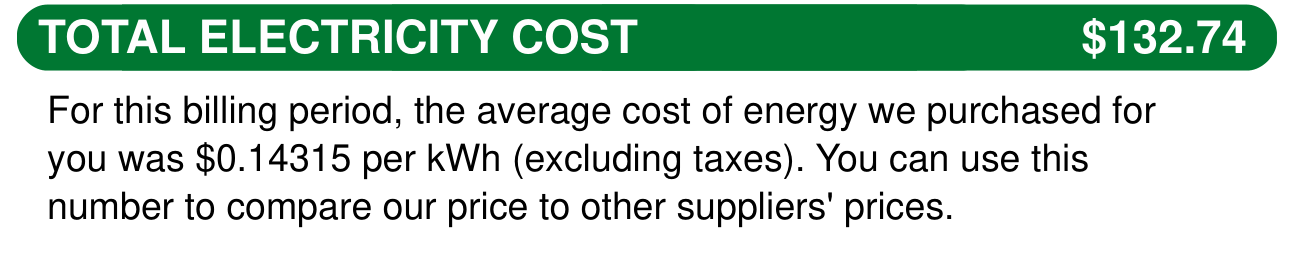
To get your true rate, take the total electricity cost and divide by the kilowatt hours you used. On this bill:
$132.74 ÷ 359 kWh = about 37 cents per kilowatt hour.
That’s the real number. Not 18 cents, not 14 – it’s 37. More than double the supply rate this homeowner would have quoted you. And because so much of that 37 cents is fixed, the fewer kilowatt hours you use, the higher your effective per-kWh rate climbs, since you’re spreading that flat $22.50 over less power. The person who conserves the most gets the worst rate per unit. That’s how this structure works.
To find yours: total electricity cost divided by billed usage, both on page three.
How to Read Your Central Hudson Usage Graph
It’s the most useful part of the whole statement. Central Hudson prints a bar graph of your last thirteen months of electricity use.
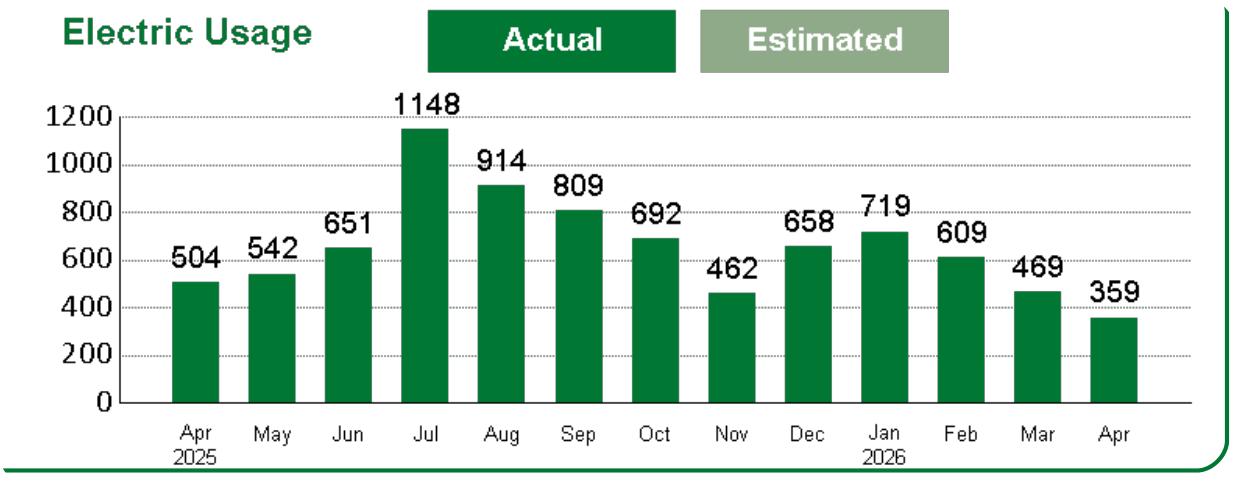
Look at the shape. The tall bars are July and August. That’s central air doing the work in summer. The low bars are spring and fall, when the house barely needs heating or cooling. This is a cooling-driven home, and you can read its whole year in one glance.
That pattern is exactly why this graph matters if you’re thinking about solar. Add up all twelve months and you get the home’s true annual usage, the single most important number for sizing a system. A quote built on one bill is a guess. One built on a full year of real usage, pulled straight from your Central Hudson account, is an actual plan. This is the first thing anyone serious will ask to see.
The Central Hudson Rate Increase, and The Billing Mess Behind It
In 2025, the state approved a three-year rate plan for Central Hudson. Delivery rates rise each year through mid-2028 – the per-kWh electric delivery charge went from about 13.86 cents to 14.55 cents on July 1, 2026, and that flat Basic Service Charge is scheduled to climb from $21.50 toward $26.00 by the final year. So the bill in front of us, at 13.861 cents, is already a touch behind current rates.
But the rate increase isn’t the whole story. Central Hudson spent the last few years mired in a billing scandal – a botched billing system that sent customers wildly wrong bills, some hundreds or thousands of dollars off. It got bad enough that the utility agreed to a $62.6 million settlement with the state, was forced to bring in an independent monitor, and had to stop the estimated-billing practices that caused much of the mess. Local officials logged more than 11,000 formal complaints.
We covered the broader New York rate picture, Central Hudson included, here: Why New York Electric Bills Are About to Spike Again.
The throughline for how you read your bill: the charge Central Hudson keeps raising is delivery. It’s the half you can’t shop, can’t opt out of, and can’t lower by using less. Which brings us to the one thing that actually changes the math.
How to Lower Your Central Hudson Bill
Some of this you can act on. Start with what’s free.
Check whether you qualify for Central Hudson’s Enhanced Energy Affordability Program. They recently expanded who’s eligible for monthly bill credits, and a lot of households that now qualify never signed up. It’s at CentralHudson.com/EEAP.
Look at your supply rate. Central Hudson prints their average supply price right on page three so you can compare it against ESCO offers. Just go in clear-eyed about the contracts, and remember it only touches the supply half.
Make sure your reads say “Actual,” not “Estimated”, especially given Central Hudson’s estimated-billing history, this is one you might want to every month. And glance at the billing period length before you panic about a jump.
Then be honest with yourself about the ceiling, because this is the whole point of this post. You saw it in the numbers: this household cut usage by 29% and the bill barely moved, because the flat charge, the riders, and the delivery structure don’t care how careful you are. Efficiency is real and worth doing: better insulation, a smart thermostat, efficient appliances. It just runs into a wall, and that wall is the fixed, rising, un-shoppable delivery charge.
Where Solar Fits In
Fair disclosure: we install solar. So take this section knowing that, and check the math against your own bill rather than my word.
Everything I’ve walked you through is a cost pointed one direction, set by a rate case you’re not part of, on a service with no competitor. Using less changes how much power you buy. It doesn’t change the direction of the price, and it doesn’t touch the fixed charges that make up so much of the bill.
Producing your own power changes what you’re exposed to. Every kilowatt hour off your roof is one you’re not buying at that all-in 37 cents, and not buying at whatever it climbs to as the rate plan rolls forward through 2028. It won’t get you off the grid completely. You’ll still have a meter, you’ll still pay that Basic Service Charge. Anyone who tells you solar zeroes out the whole bill is overselling it.
What solar actually does is take the biggest, fastest-growing line on your bill and swap most of it for a number you lock in today. Whether it works for your house depends on your roof, your usage, your shade, and the incentives you qualify for. Which is exactly why that thirteen-month usage graph is where the real conversation starts.
Central Hudson Bill FAQ
Why didn’t my bill go down when I used less electricity? Because most of your bill isn’t based on usage. The flat Basic Service Charge ($22.50) and the various delivery riders stay the same no matter how much power you use. Only the per-kWh delivery and supply charges shrink when you cut back, so the total barely moves.
Why is my delivery charge higher than my supply charge? On Central Hudson, it’s not because the delivery rate is higher, this month supply per kWh actually cost more. Delivery totals more because it carries all the fixed charges: the flat monthly fee, the riders, and the adjustments that don’t scale with usage.
What is the Basic Service Charge? A flat monthly fee ($22.50 on this bill) for being connected, covering the meter, meter reading, and part of the delivery system. You pay it even if you use zero electricity, and it’s scheduled to rise under the current rate plan.
What is the RDM charge? The Revenue Decoupling Mechanism – a true-up that lets Central Hudson recover the difference when actual delivery revenue comes in below forecast. It’s the reason neighborhood-wide conservation doesn’t cut the utility’s delivery income the way you’d expect.
Can I lower my bill by switching suppliers? You can change your supply cost and possibly drop a small charge, but switching to an ESCO does nothing to your delivery charges, because Central Hudson still owns the wires and still bills you for delivery.
How do I find my real cost per kWh? Take the “Total Electricity Cost” on page three and divide by the “Electricity Used (kWh).” It comes out well above the supply rate, and it climbs higher the less you use, because the fixed charges spread over fewer kilowatt hours.
See Your Own Number
Pull your last twelve months of usage from your Central Hudson account and take two minutes with the survey below. We’ll put together a free savings plan showing what your roof would produce, what it would cost, and how it stacks against a bill that keeps rising no matter how carefully you use power.