PPL’s electricity rate is about 13 cents per kWh right now. But is that what you’re actually paying for electricity?
This is a real PPL bill from a house in Northeast Pennsylvania. It came to $469 for one month. We’re going to go through it from top to bottom, explain where that difference comes from, and show you how to calculate your own electricity costs. The owner said we could share it, and we took off the name, address and account number.
What’s interesting about this bill is that while PPL’s listed electricity supply rate is about 13 cents per kWh, the homeowner is actually paying closer to 20 cents.
If you have your own PPL bill, grab it and follow along. Yours is set up the same way.
PPL bill at a glance
| November 2026 | |
|---|---|
| Total bill | $469.02 |
| Electricity used | 2,358 kWh |
| Supply charges | $308.41 |
| Delivery charges | $160.61 |
| Price to Compare | 13.079¢/kWh |
| Actual cost per kWh | 19.89¢/kWh |
Supply and delivery charges
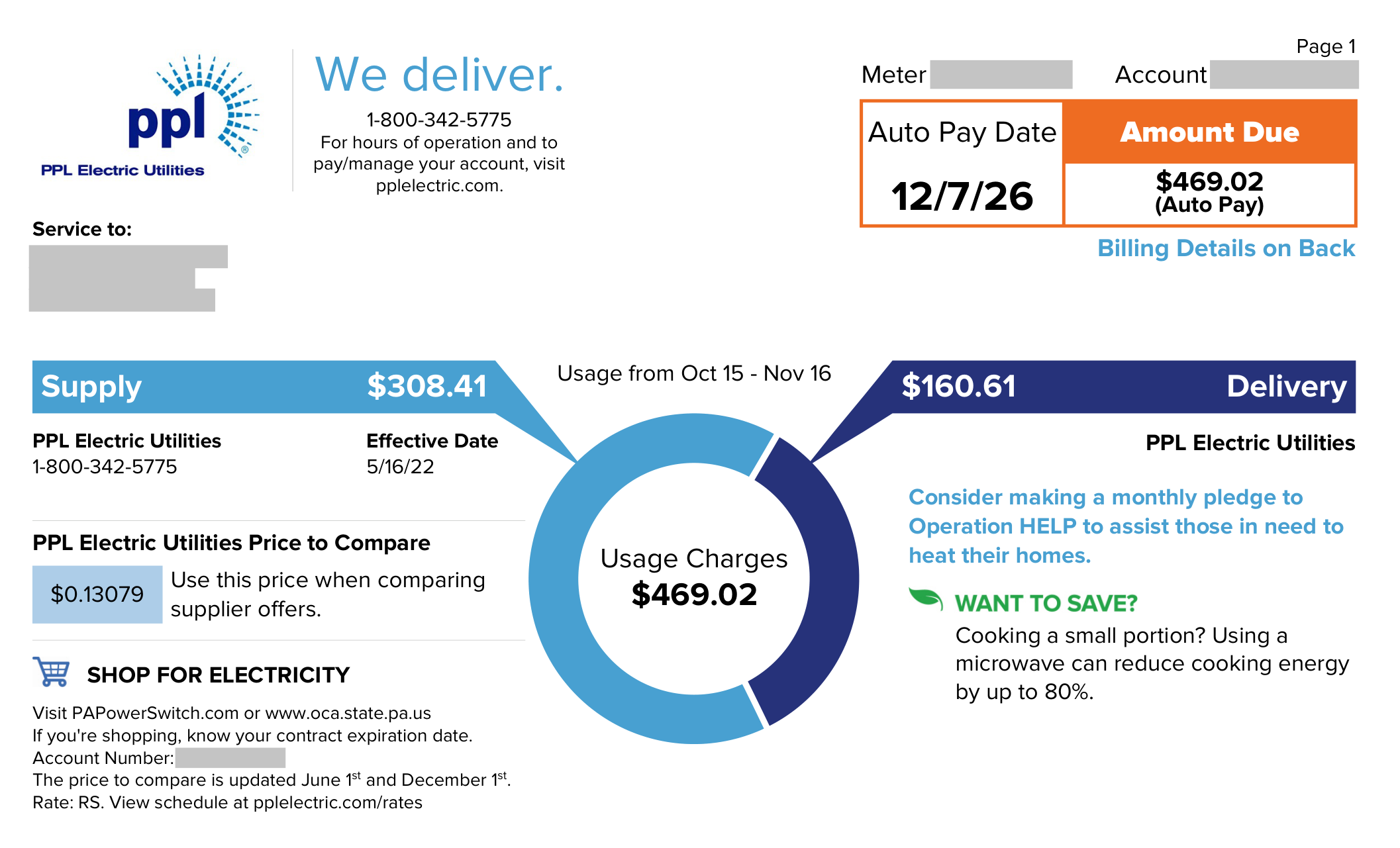
Start at the top right of the first page. That’s the amount due, $469.02, and the date the payment is scheduled. Below that, you’ll see a blue circle where PPL splits your electricity charges into two parts:
- Supply: What you pay for the electricity itself, including generation and transmission.
- Delivery: What PPL charges to bring electricity to your home through its local network of poles, wires and meters.
On this bill, supply comes to $308.41 and delivery to $160.61. Roughly two-thirds of the bill goes toward supply.
In Pennsylvania, you can choose your electricity supplier, but not your utility company. Regardless of who supplies your electricity, PPL will continue delivering it to your home.
What is the PPL Price to Compare?
On the left side of the bill, there’s a box labeled Price to Compare. On this bill, it’s $0.13079, or just over 13 cents per kWh. If another electricity supplier offers you a different rate, this is the number you should compare it against. Remember, though, that the Price to Compare is only the supply portion of your bill, not the full price you pay for electricity.
You’ll also notice an Effective Date beneath the supplier information. On this bill, it’s May 16, 2022. This is associated with the supplier serving the account, not the date of the latest electricity rate change.
Reading your electricity usage
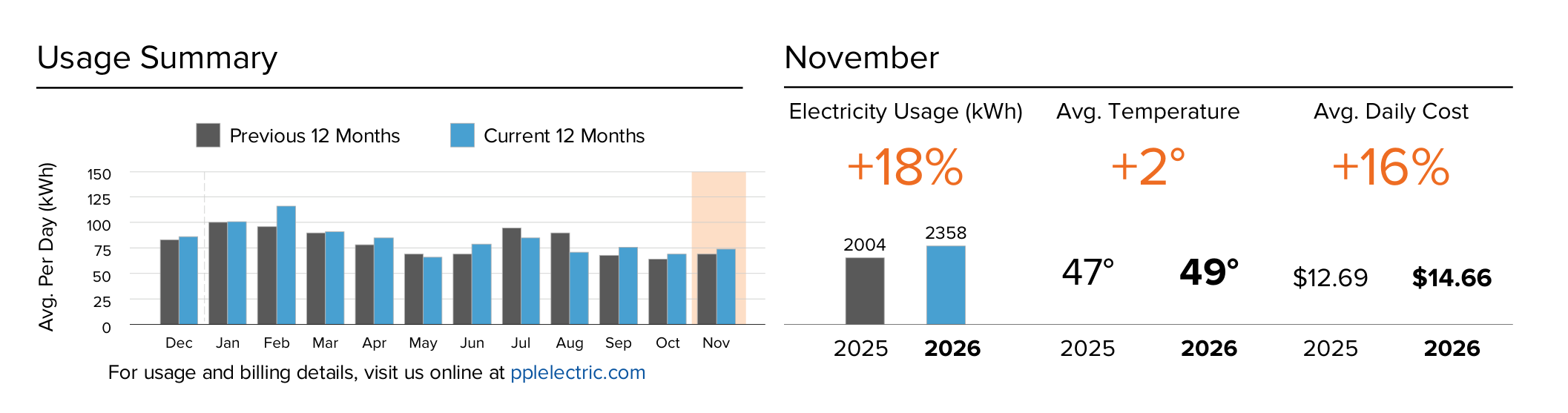
Lower on the first page is a graph showing the home’s average daily electricity usage throughout the year. Gray represents the previous year, and blue represents the current year. This particular home uses the most electricity in February. If you see a similar pattern on your bill, electric heating may be contributing to your winter expenses.
Next to the graph is a year-over-year comparison for the current billing month.
| November 2025 | November 2026 | |
|---|---|---|
| Electricity usage | 2,004 kWh | 2,358 kWh |
| Average temperature | 47°F | 49°F |
| Average daily cost | $12.69 | $14.66 |
The household used 18% more electricity this November, even though it was slightly warmer. The bill doesn’t tell us exactly why. It could be a space heater, an electric vehicle, a new appliance or simply a change in how the household uses electricity. If your bill has gone up, this is a good place to start looking before assuming it’s entirely due to a rate increase.
Monthly and annual electricity usage
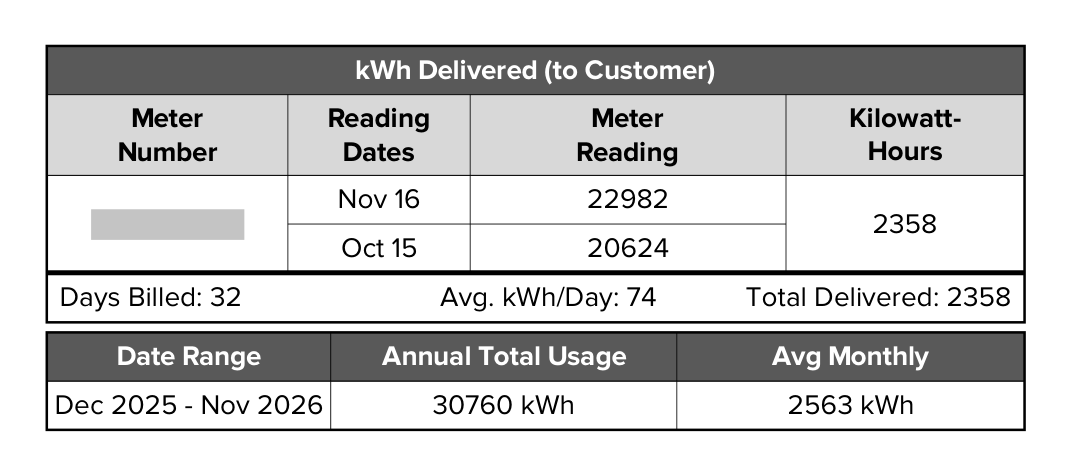
Flip to page two. The box at the top left shows your meter readings, how many kilowatt-hours you used and how many days the bill covers. This household used 2,358 kWh over 32 days, averaging about 74 kWh per day. Some billing periods are longer than others, so if you’re comparing bills, look at your average daily usage rather than just the monthly total.
Below that is another useful number: your annual electricity consumption. This home used 30,760 kWh over the last 12 months, averaging 2,563 kWh per month. That’s considerably more than the 1,000 kWh residential usage example PPL commonly uses when illustrating rate changes. If you ever get a quote for solar, this annual usage figure is one of the first things your installer will look at.
A Closer Look at Supply Charges
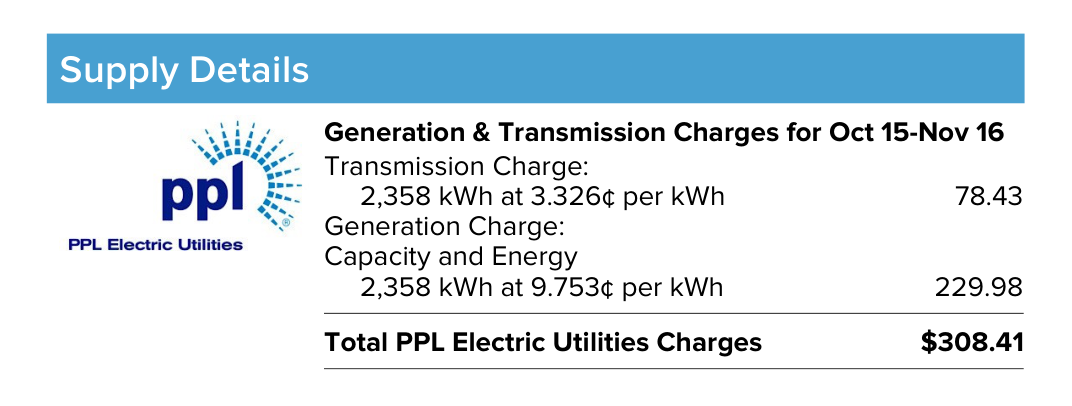
Further down page two, PPL breaks the supply portion into two separate charges: generation and transmission. Generation is the cost of producing electricity, while transmission is the cost of moving it across high-voltage power lines before it reaches your local distribution network.
Add those two rates together and you get 13.079 cents per kWh — the same Price to Compare we saw on the first page. If you purchase electricity from another supplier, you’ll see their name and applicable charges in this section instead.
A Closer Look at Delivery Charges
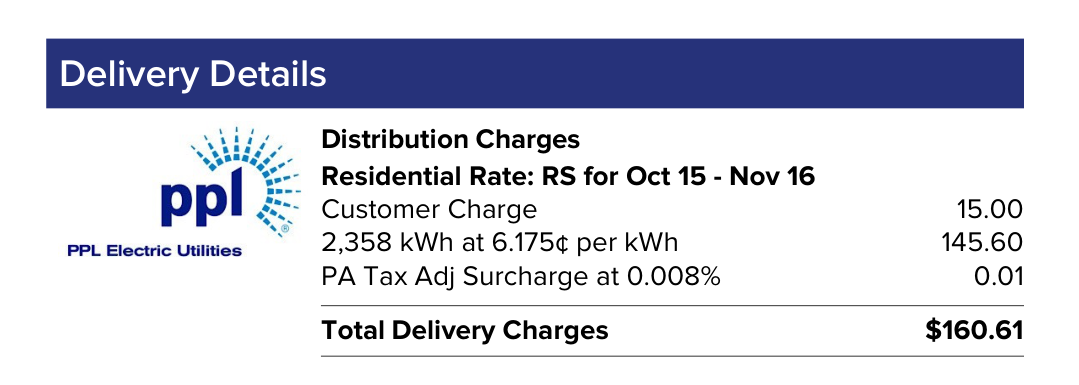
This is PPL’s delivery portion of the bill. The $15 customer charge is a fixed monthly fee that you pay even if you barely use any electricity that month. The distribution charge, on the other hand, depends on how much electricity you use. On this bill, it’s 6.175 cents per kWh.
This is why switching electricity suppliers can only reduce part of your bill. You might find a better supply rate, but PPL’s delivery charges will still be there.
Taxes on Your PPL Bill

Just above the supply details, PPL lists two estimated tax amounts. On this bill, state taxes come to approximately $4.54 and the Pennsylvania Gross Receipts Tax to approximately $27.67. These aren’t additional charges you need to add to your bill. They’re already included in the amounts we’ve covered above. PPL lists them separately for your information.
What Are You Really Paying per kWh?
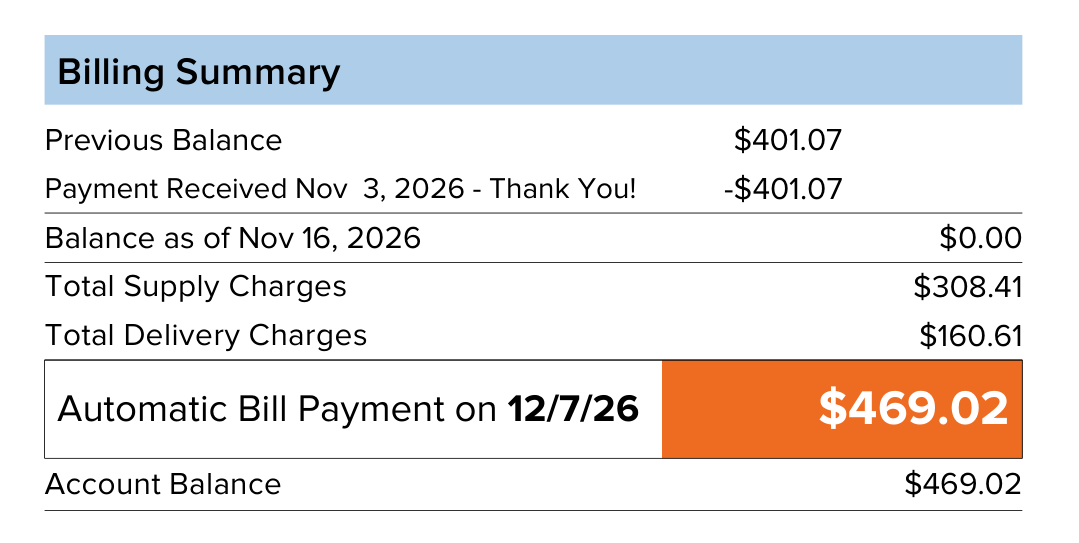
Now that we’ve gone through the individual charges, let’s put everything together. The Price to Compare says 13.079 cents per kWh, but that only accounts for supply. To find out what this household actually paid for electricity, we can divide the total current charges by the amount of electricity used.
$469.02 ÷ 2,358 kWh = 19.89¢ per kWh
That’s approximately 52% higher than the listed supply rate. If we exclude the fixed $15 customer charge, the electricity-related cost comes to approximately 19.25 cents per kWh.
You can do the same calculation with your own bill. Just make sure you’re using the current month’s charges, not a total that includes an unpaid balance from a previous month.
PPL’s December 2026 Rate Increase
PPL updates its Price to Compare twice a year, on June 1 and December 1. On December 1, 2026, the residential rate is going up from 13.079 to 14.428 cents per kWh, an increase of 10.31%.
Here’s what that means for your monthly bill if your electricity usage and delivery charges stay the same.
| Monthly usage | Additional monthly cost |
|---|---|
| 500 kWh | $6.75 |
| 1,000 kWh | $13.49 |
| 1,500 kWh | $20.24 |
| 2,000 kWh | $26.98 |
| 2,500 kWh | $33.73 |
For the household in our example, the same amount of electricity would bring the bill from $469.02 to approximately $500.83. That’s another $32 for the same monthly electricity usage. PPL also increased its distribution base rates on July 1, 2026, so this isn’t the only rate change homeowners have experienced this year.
You can always check the latest electricity supply rates directly on PPL’s website.
How to Lower Your PPL Bill
Shop around for electricity. Since supply accounts for a significant portion of your bill, finding a lower rate can make a difference. You can compare suppliers at PAPowerSwitch.com. Pay attention to monthly fees, cancellation penalties and rates that increase after an introductory period.
Find out what’s using the power. If your electricity consumption has gone up, look at what’s changed around the house. Heating, cooling, water heaters and older appliances are good places to start. Comparing your average daily usage with the same period last year can help you narrow things down.
Consider Budget Billing. PPL can average your electricity costs throughout the year so your winter bills aren’t quite as painful. You’ll still pay for the same amount of electricity overall, but your monthly payments will be more predictable.
See if you qualify for assistance. PPL offers programs such as OnTrack and Operation HELP. Pennsylvania homeowners may also qualify for LIHEAP, the federal heating assistance program.
How Solar Affects Your PPL Bill
We install solar in Pennsylvania, and this bill is a good example of why we look at more than just the advertised electricity rate when calculating potential savings. When your solar panels produce electricity that you use in your home, you’re avoiding the cost of purchasing that electricity from the grid, including supply and usage-based delivery charges.
PPL also offers net metering for eligible customers. When your panels produce more electricity than your house needs, the excess goes back to the grid. You can use those credits later, when your panels aren’t producing enough to cover your consumption, such as at night or during the winter months.
That doesn’t mean your PPL bill disappears entirely. The monthly customer charge remains, and you’ll still pay for electricity that isn’t covered by your solar production or available credits. If you produce more electricity than you use over the entire annual settlement period and PPL is your supplier, the remaining excess is generally paid out at the Price to Compare. That’s less than the full retail rate those credits can offset during the year.
It’s one of the reasons we size solar systems around a home’s actual electricity consumption rather than simply putting as many panels on the roof as possible. Whether solar makes sense for your home depends on your roof, shading, electricity usage and available financing options. If you’re a Pennsylvania homeowner looking to reduce your PPL bill, check below to see if you qualify for $0 down solar and find out what your potential savings could look like.
Check If You Qualify for $0 Down Solar in Pennsylvania →
Common Questions About Your PPL Bill
Why is my PPL bill so high?
A higher PPL bill can be caused by increased electricity usage, changes in supply or delivery rates, a longer billing period or an estimated meter reading. Start by comparing your average daily electricity usage and rates with previous bills to see what changed.
How much does PPL charge per kWh in 2026?
PPL’s residential default supply rate is 13.079 cents per kWh through November 30, 2026, and 14.428 cents per kWh from December 1, 2026, through May 31, 2027. Delivery charges and the monthly customer charge are additional, so your actual cost per kWh will be higher.
What is the PPL Price to Compare?
The Price to Compare is PPL’s default electricity supply rate, including generation and transmission. You’ll find it on the first page of your bill. It’s the rate you should use when comparing offers from other electricity suppliers in Pennsylvania. It does not include delivery charges or the monthly customer charge.
How do I calculate my actual electricity cost per kWh?
Divide your current electricity charges by the number of kilowatt-hours you used during the billing period. For example, a $469.02 bill for 2,358 kWh works out to 19.89 cents per kWh. Make sure you exclude any unpaid balances from previous months.
How much is a PPL bill for 1,000 kWh?
Using the December 2026 supply rate of 14.428 cents per kWh, the distribution rate of 6.175 cents per kWh and the $15 monthly customer charge, a household using 1,000 kWh would pay approximately $221 per month, assuming delivery rates remain unchanged. Your actual bill may vary depending on your supplier and applicable charges.
Is PPL raising electricity rates in December 2026?
Yes. PPL’s residential Price to Compare will increase from 13.079 to 14.428 cents per kWh on December 1, 2026. That’s a 10.31% increase in the default supply rate, or an additional $13.49 per month for a household using 1,000 kWh, assuming other charges remain unchanged.
What is the difference between supply and delivery on a PPL bill?
Supply covers the cost of generating electricity and transmitting it across the regional power grid. Delivery covers the cost of distributing that electricity to your home through PPL’s local network of poles, wires and meters.
What is the customer charge on my PPL bill?
The standard residential customer charge is a fixed $15 monthly fee that helps cover billing, meter reading, equipment and service line maintenance. Unlike usage-based charges, it does not decrease when you use less electricity.
Will switching electricity suppliers lower my PPL bill?
It can if the new supplier offers a lower supply rate without additional fees that cancel out your savings. Switching suppliers will not change your PPL delivery rates or monthly customer charge. You can compare supplier offers at PAPowerSwitch.com.
Where can I find my annual electricity usage on a PPL bill?
Look for the Annual Total Usage table near the top left of page two. It shows your electricity consumption over the previous 12 months, along with your average monthly usage. This is particularly useful when evaluating your home’s energy consumption or getting a solar quote.
What should I do if I think PPL is overcharging me?
Check your meter readings, billing period, electricity usage and applicable rates on page two of your bill. If the charges still don’t look right, contact PPL at 1-800-342-5775. If you’re unable to resolve the issue, you can contact the Pennsylvania Public Utility Commission’s Bureau of Consumer Services at 1-800-692-7380.
Can solar panels reduce my PPL bill?
Yes. Solar panels can reduce the amount of electricity you purchase from the grid, lowering both supply and usage-based delivery charges. Through PPL’s net metering program, eligible customers can also receive credits for excess electricity sent to the grid. Your savings depend on your electricity usage, system production and applicable rates.
Will I still receive a PPL bill after installing solar?
Yes. Grid-connected solar customers generally continue receiving monthly PPL bills. The fixed customer charge remains, along with any electricity charges that are not offset by solar production or available net metering credits.