Ask most Con Ed customers what they pay for a kilowatt hour and they’ll squint at their bill and read you the supply rate. Something around thirteen cents. Fair enough, it’s right there on the page. It’s also not what they’re paying.
On the bill I’m about to walk you through, the real rate was thirty-six and a half cents. Almost triple. And this isn’t some unusual bill I went hunting for. It’s a normal single-family home in Westchester, one month of electricity, nothing weird going on. Once you know how to read it, you’ll be able to find your own real number in about thirty seconds, and I’ll show you where to look.
Everything below comes from one actual statement: 657 kilowatt hours used, billed late January through late February 2026, $240.02 due.
Supply vs Delivery Charges on Your Con Ed Bill
Turn to the page headed “Your electricity breakdown.” Your charges sit in two columns. Supply on the left, delivery on the right. Most people glance at supply and stop, because that’s the part that sounds like “the electricity.”
But supply is the small column. Take a look:
- Supply came to $90.92. That’s the actual energy your house used, bought at market price. Con Ed doesn’t make a dime on it.
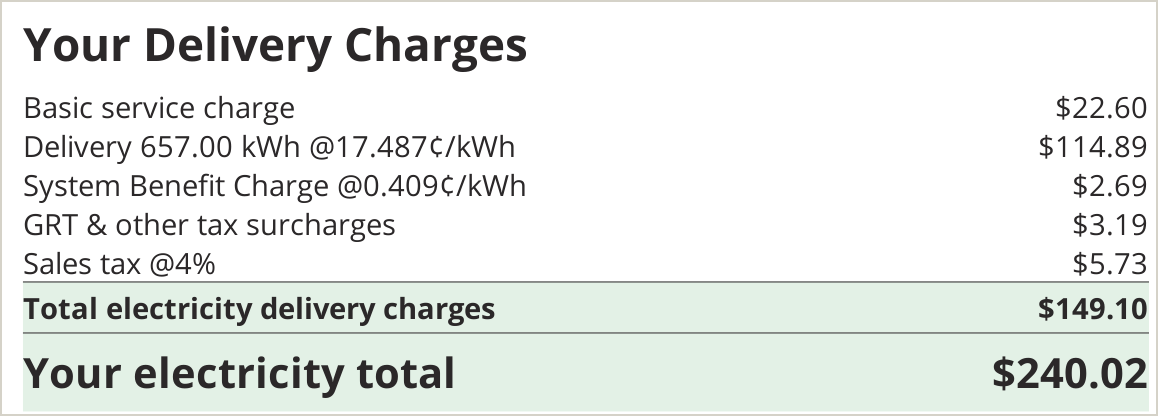
- Delivery came to $149.10. That’s what Con Ed charges to move that energy over the wires to your house. This is the part the state lets them raise, and they’ve been raising it for years.
So delivery was 62% of your electricity charge. It cost more to ship the power than to make it. And you can’t shop that part around. You can switch suppliers, you can use less, you can seal up every draft in the house, and delivery doesn’t budge. Con Ed owns the wires and nobody else is allowed to string a set next to theirs.
That’s the thing to hold onto. Now let me show you how that delivery number gets built, because it’s most of what you’re paying.
The Basic Service Charge: what you pay before using anything
First line in the delivery column is the Basic Service Charge, $22.60.
You pay this one no matter what. Go away for the month, kill the main breaker, use nothing at all, and it still shows up. Con Ed calls it “basic system infrastructure and customer-related services,” which is a long way of saying the cost of keeping you hooked up and sending you a bill. There’s a $1.73 billing fee tucked inside it too. So before you’ve used a single kilowatt hour, you already owe $22.60.
The line that does the real damage
Delivery, 657 kWh at 17.487¢ per kWh, $114.89.
Look at that rate again. Con Ed charged you 17.487 cents to deliver each kilowatt hour, and only 12.773 cents for the actual energy. The delivery costs more than the power. This single line is the biggest charge on your whole bill, more than everything on the supply side put together, and it’s the number that goes up every time there’s a rate case.
This is also why cutting back doesn’t help as much as you’d think. Every kilowatt hour you use gets hit with this rate, and it climbs a little every year, and that fixed charge from the last section just sits there no matter how careful you are.

While you’re on this row, glance at the read type every month. Con Ed uses smart meters now so estimates are rarer than they used to be, but if you see “Estimated” and it came in low, you’ll get a catch-up bill later to make up for it. And trust the “Total Usage” number, 657 here. The two reads next to it are rounded off, so if you subtract them yourself the math won’t always line up.
The little stuff at the bottom
Three smaller lines round out the delivery column:
System Benefits Charge, $2.69. A state charge that pays for efficiency and renewable programs run through Con Ed and NYSERDA. Pennies per kilowatt hour, but everyone in New York pays it every month, and it’s part of what funds the state’s solar incentives.
GRT and other tax surcharges, $3.19. Taxes on Con Ed’s revenue, handed down to you.
Sales tax, $5.73.
That brings delivery to $149.10. And of that, $137.49 is the two lines you can do absolutely nothing about, the fixed charge and the delivery rate. Almost the entire biggest half of your bill is out of your hands.
Now the cheap column
Supply is quick once you understand delivery.
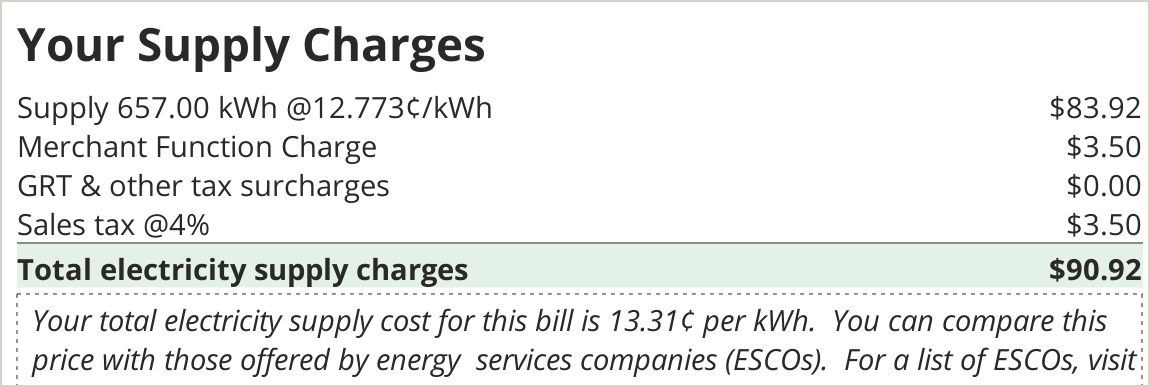
Supply, 657 kWh at 12.773¢, $83.92. The energy itself, at whatever the market was charging. If you use a third-party supplier (an ESCO), their rate shows up here instead.
Merchant Function Charge, $3.50. What Con Ed charges to go buy that energy for you and cover the billing and collections behind it. It only shows up when Con Ed is your supplier. Switch to an ESCO and it’s gone.
Then a $0.00 tax surcharge line and $3.50 in sales tax, for a supply total of $90.92.
One genuinely useful thing Con Ed does here: right under that total, it prints your blended supply rate, 13.31¢ on this bill, and tells you to compare it against ESCO offers. That’s the number a supplier will call you trying to beat. Handy to know before your phone rings.
How to calculate your real cost per kWh
You’ve got all the pieces now.
| Supply | $90.92 |
| Delivery | $149.10 |
| Total | $240.02 |
| Used | 657 kWh |
The rate you’d quote (supply only): $90.92 ÷ 657 = about 13.8¢ per kWh.
The rate you actually paid (all of it): $240.02 ÷ 657 = about 36.5¢ per kWh.
The energy cost fourteen cents. The bill cost thirty-seven. Your bank account never sees that supply rate, it only ever feels the total, and the total was more than two and a half times what this homeowner would have told you they pay.
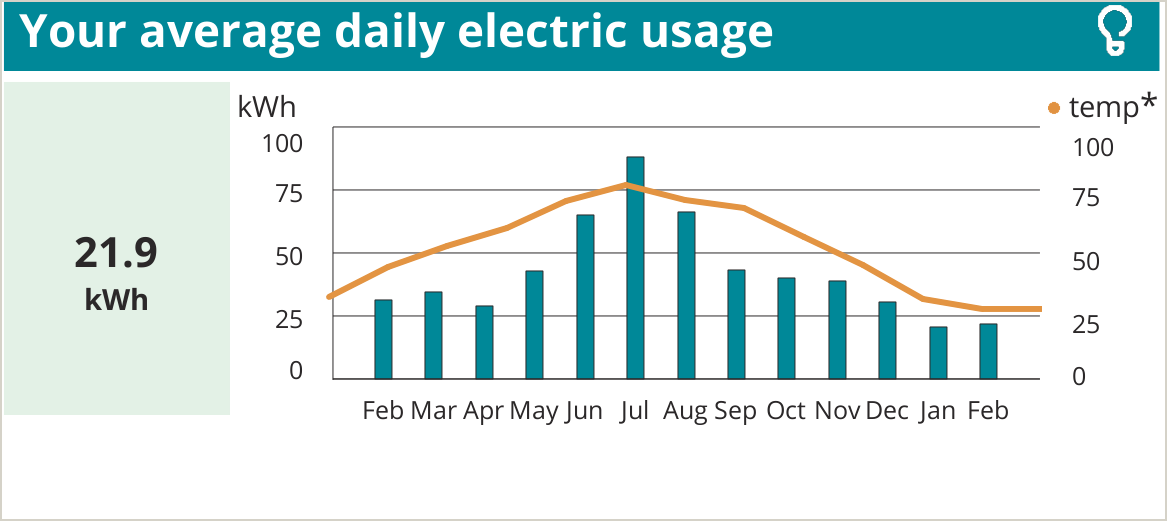
And remember, this was winter. Con Ed prints a graph of your last thirteen months on page one, and on this house the bars nearly triple by July when the AC kicks in. A home running at that level year-round is spending north of $2,500 a year on electricity, before the latest increases have fully shown up.
The 2026 Con Edison rate increase
It’s not staying at 36.5¢. If that number held steady you could at least budget around it. It won’t.
Back in January 2026 the state approved a multi-year rate plan for Con Ed. Not one hike, a series of them:
- 2026: about 3.5%
- 2027: about 3.2%
- 2028: about 3.1%
Call it 9.8% over three years. To be fair, Con Ed asked for a lot more than that and got talked down. But the thing to understand is how these stack. Each increase builds on the one before it. The rate never drops back to where it started, so you’re paying 3% more on top of an already higher number, then again the year after. It adds up faster than the small yearly percentages make it sound.
And since it’s the delivery side going up, using less won’t save you from it. The fixed charge doesn’t care how careful you are, and the delivery rate hits every kilowatt hour you do use, at a number that goes up every spring.
We wrote about the 2026 increase on its own if you want the full story: Con Edison Announces New Rate Increases… Again.
What you can actually do about it
Some of this you can control. Start with the stuff that’s free.
See if you qualify for Con Ed’s affordability programs. They run bill discounts and payment help for income-eligible households, plus EnergyShare grants if you’ve fallen behind, and a lot of people who qualify never sign up.
Keep an eye on your supplier. Con Ed prints your supply rate right there (13.31¢) so you can compare it to ESCOs, but read those contracts carefully, because variable-rate deals have burned plenty of people, and switching only affects the supply half anyway.
Make sure your reads are actual, and check how many days are in the billing cycle before you panic about a jump. A long month looks like a rate hike if you don’t notice the day count.
Then be honest with yourself about the limits. Better insulation, a smart thermostat, efficient appliances, all of it helps, and you should do it. But look back at that delivery column. The fixed charge doesn’t move when you cut back, and the delivery rate keeps climbing regardless. Using less still helps. It just doesn’t protect you the way it did ten years ago.
The one line you can actually change
We install solar, so read this part knowing that, and check the math against your own bill.
Here’s the simple version. Everything I just walked you through is a cost that only moves one direction, set by people you’ll never talk to, on a service you can’t buy from anyone else. Using less changes how much you buy. It doesn’t change which way the price is headed.
Making your own power changes what you’re exposed to. Every kilowatt hour off your roof is one you’re not buying at 36.5 cents, and not buying at whatever that turns into after the 2027 and 2028 increases land. It doesn’t get you off the grid. You’ll still have a meter, you’ll still pay that Basic Service Charge, and you’ll still pull power at night. Anybody who tells you solar makes the whole bill disappear is overselling it.
What it does is take the biggest, fastest-growing line on your bill, that 17.487¢ delivery rate on every kilowatt hour going up every year, and swap most of it for a number you lock in now. Whether that works for your house depends on your roof, your usage, your shade, and what incentives you qualify for. Which is why that usage graph is the first thing anyone should actually look at.
A few quick questions people ask
Why does Con Ed charge more to deliver the power than to supply it? Because delivery covers the whole distribution system, not just the energy, a fixed service charge plus a per-kWh rate that on this bill was actually higher than the supply rate. Delivery was 62% of the total.
Will switching to an ESCO cut my delivery charges? No. It changes who bills you for supply and drops the Merchant Function Charge. Delivery stays exactly the same, because Con Ed still owns the wires.
What’s the Merchant Function Charge? Con Ed’s cost to buy your supply and handle the credit and collections behind it. It only shows up when Con Ed is your supplier.
What’s the System Benefits Charge? A state charge that funds efficiency and renewable programs through Con Ed and NYSERDA. Con Ed collects it, but it doesn’t pay for your power.
My usage went down, so why did my bill go up? Usually the 2026 delivery increase, a longer billing cycle, or a correction after an estimated read. Check the meter detail for “Estimated” and count the days in the cycle.
How do I find my own real rate? Take your total electricity charge and divide by the kWh on your meter detail. Almost everyone lands well above the supply rate on the bill.
See your own number
Pull your last twelve months of usage from your Con Ed account and take two minutes with the survey below. We’ll put together a free savings plan showing what your roof would make, what it would cost, and how that stacks up against a bill that’s set to keep climbing through 2028. No pressure and no obligation.